Friday, May 15, 2015

Colorful Dodecahedrons

A couple of weeks ago, I was looking for interesting ways to gather feedback from my students.  I wanted to get a feel of how my two Geometry Honors classes felt the second half of the year went.  At the semester break, their former teacher left for a family illness and my schedule was revamped to take these two classes.  I fell in love with these students immediately.  They were hard-working, curious individuals that, I have found recently, love a challenge.

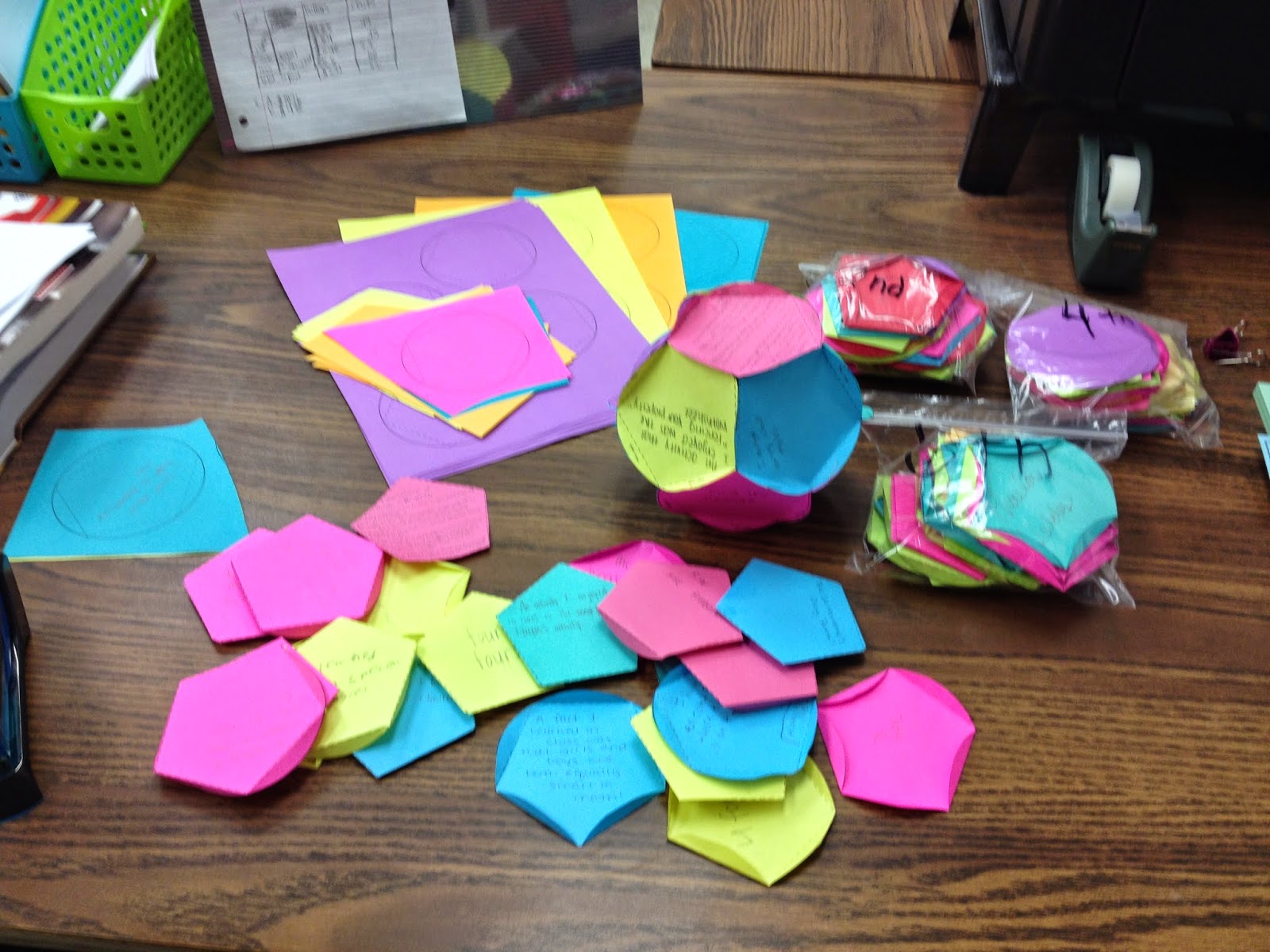
So my choice of search for all things awesome sent me to Pinterest!  It was there that I found the colorful dodecahedrons created by 12 inscribed pentagons and numerous staples! So as the pin was on my screen, I opened Geometer's Sketchpad and created this template.   (I later created a larger version for next year.)

I was only planning to have my Geometry Honors classes participate, but I woke up with the beginnings of a migraine and decided my Algebra 2 classes could do the same thing.  I went into school before the kids arrived and made copies on colored paper.  While I was setting my room up for my sub, she walked in.  I briefly explained that each student needed to fill out 2 pentagons, cut the circles out and fold on the dotted lines (pentagon).  For each shape, they were to write about a lesson they learned this year and/or an activity that they enjoyed.


When I came back in the next day, my awesome sub had found my Ziploc baggies, filled each one with a class of pentagons and labelled them!!  For the next two periods, while my students worked on their surface area/volume project, I walked around with a few pentagons and a stapler in my hand, putting together a total of 14 dodecahedrons.  (It took over a day to staple them all.)  As I was walking around, my kids asked questions about the shape that I was creating.  So, I showed them a finished one and asked them to guess how many pentagons made the solid.  They were really into guessing and many got it right the first time.  I then asked what it was called.  After a couple seconds they were able to tell me dodecahedron (some said dodecagon first and I just waited).

The next day during my planning period, which fortunately is attached to my lunchtime (!!!), I hung them from the ceiling with fishing line.  I thought 14 would be too many, but once I got them all up, I wished I had more.  That's why I created a larger version of the inscribed pentagons so it would fill up more space, plus the students would be expected to write more details.

I have passed this project idea along to a couple of colleagues and look forward to sharing with other teachers during post-planning this year, or pre-planning next year.  While this is not my original idea, it is an original template.

I need to pull one of them down and count the number of staples.  That will be a question I ask my students.  I love to listen to them explain their thinking!


I loved reading this "fact" she learned!!

I wrote about the Four Fours activity here.


Some were just sweet comments...


Piling 'em up!


See how small they are once they were hung up?  Definitely gonna make larger ones next year.


Panoramic picture of my classroom from my exterior door.

Tuesday, May 5, 2015

Matrices

As the year draws to a close and EOC tests are done, my Algebra 2 classes will be conquering matrices and its role in cryptography.  Matrices were not tested on their EOC, so it was saved till now.

In anticipation for starting matrices tomorrow, I began last year revamping my old lessons.  I pulled out examination textbooks I have collected over the years to find multiple step word problems and hit the internet for areas that use matrices.  The first document was 4-part notes.  After each part, a discussion would be held and a formative assessment sheet would be given.  Here is the lesson plan I shared with a friend that also teaches Algebra 2 at my school:

Lesson Plan for Matrices Unit
Matrices Inquiry worksheet are the “notes”.
Day 1: Part 1 Matrices Inquiry, CW/HW Data in Matrices Sheet
Day 2: Part 2 Matrices Inquiry, CW/HW Matrix Add, Subtract & Scalar Mult. Sheet
            HW: watch video (https://www.youtube.com/watch?v=kuixY2bCc_0)
Day 3: Part 3 Matrices Inquiry, CW/HW Matrix Multiplication (pgs. 1-2)
Day 4: CW Matrix Multiplication Sheet (pgs. 3-4)

The 12-page zip file can be found at my TPT store.
Matrices Inquiry Notes - 4 pages
Data in Matrices - 2 pages
Add/Subtract/Scalar Multiplication - 2 pages
Matrix Multiplication - 4 pages

Below is a preview of Part 2 of the Matrices Inquiry Notes:

I will be continuing to add to this lesson to include determinants and inverses of a 2x2 matrix, to get to the fun cryptography part.

Friday, May 1, 2015

Four Fours Worksheet

My Geometry Honors students took their EOC this past Monday and Tuesday.  So the rest of this week, I have been giving them miscellaneous mini challenges, nothing too deep.  One day they had to find a buried treasure using geometric constructions.  Today, I gave them the Four Fours Worksheet.  All students were engaged with this worksheet, even those that mentally drift off.  They were getting frustrated ("I'm gonna break this calculator!", "This is harder than the EOC!"), but they would not let it beat them.  The office called to tell me one of my girls was checking out.  She is typically chatty and not-so-engaged.  She told me, "I only have 2 more to find and I'm not leaving till I get them!".  She checked out 5 minutes later, AFTER she found the last two!  Needless to say, it was a good day!  Here's the link to my version of the Four Fours Wkst.

Monday, April 20, 2015

Promise to Start Blogging Again...More Often

Over the past year, I have gone through many changes.  All of them have been for the best, even though lots of stress was involved!

  • March - bought a new car and gave my paid-off car to my daughter.
  • April - my divorce was final, hence the blog name change.
  • May - was told my teaching contract wouldn't be renewed for the following year (gotta love a superintendent that's kin to everyone!)  I had been at that school for 6 years and the district had decided not to offer tenure to new teachers at 3 years of service.  BTW, I was voted Teacher of the Year during my third year!  I see where that got me!!  Of course, it was during the previous superintendent's reign.
  • June - my "baby girl" graduated from high school, moved to a town 15 minutes away, into a condo I own and I moved out of a rented home and out of my classroom in less than a month's time (It's amazing how much "stuff" we collect over years of teaching!). I started my Masters degree online through University of Florida and began job hunting.
  • July - I was offered my current job in the same town that my daughter moved to, where my parents live and I grew up.  I actually graduated from the high school I work at now.
  • August -  school started and I began teaching Algebra 2, which I have not taught in 5 years.  My teaching philosophy and style has changed tremendously, so it was like I had to start fresh.  Even though I LOVE my new school, it has been extremely stressful.  In the fall, I battled tension headaches that would frequently turn into a migraine, sometimes 6 days a week.  Now that they are under control and I have adapted to the extra work time involved in my Masters, I want to start blogging again.  
I hope to find out soon what I will be teaching next year.  I think there will be an overload of Geometry students due to the revamping of the high school math sequencing (Alg 1, Alg 2, Geom).  I hope to have all Geometry classes.  In preparation for planning for next year, this weekend, hours were dedicated to reorganizing my computer files.  I deleted so many files that I gained 7 GBs of space!  There were so many files in my downloads, many of which I had forgotten about, that it was like Christmas going through them!

In future posts, I will share many ideas I have learned during my past 6 Masters classes.  Hopefully, this will help cement the learning with me and help me to prepare for next year.  Lots of ideas are flying through my mind, so it may take a little while to start organizing them.

Wednesday, July 9, 2014

Math by Tori (formerly Kelsoe Math)

This is the first post under my new name MathbyTori.blogspot.com.  My older posts have been imported from KelsoeMath.blogspot.com.

Thursday, January 16, 2014

Interactive Notebook Survey

I didn't want to wait until the end of the year to give out a survey for our interactive notebooks.  After their quiz today, I gave them this to fill out.  Here's a screen shot...


Of the 33 surveys, here are a few things I found out...

- Question #1 - only 16 said they had 100% completed!  That's sad!

- Question #2 - a one, no twos, 16 threes, 12 fours and 4 fives

- Question #3 - 7 ones, 13 twos, 11threes, 2 fours and no fives

- Question #4 - a one, 2 twos, 5 threes, 13 fours and 12 fives

- Question #5 - no ones, 2 twos, 10 threes, 13 fours and 8 fives

- Question #6 - Triangle Vocab Puzzle, Law of Detachment/Law of Syllogism, Parallel Lines Flashcards, Triangle/Angle/Side Congruences, Equilateral and Isosceles Triangles, Conditional Statements, Classify Triangles Cut Out Activity, cute little folders for vocabulary, Triangles Congruences wkst (Math Teacher Mambo's Worksheet), Sum of Angles in a Triangle, Exterior Angle/Remote Interior Angles, calendars - I got to customize them to my personal liking).

- Question #7 - Most liked them all, but some said: Triangle Congruences, Proof Reasoning, Distance & Midpoint, Biconditionals IFF, Constructions, lots of vocab in first unit, Segment & Angle Addition, Parallel Lines Flashcards, Table of Contents (student says, "I get off track"), Exterior Angle/Remote Interior Angles.

- Question #8 - Most wouldn't change anything, but some said: the words would glow in the dark (that would be awesome!!), there would be more cutting and gluing, table of contents (not sure what they didn't like exactly), having to number the pages, start putting it in a binder instead of a notebook (spiral) because its not as sturdy and you can't add paper if you need to (we haven't needed to add paper, but I think they may have pulled some out for other assignments), add more notes writing down step by step what to do (good idea!), how much work we do in it like how thick the back is (vocab section), never to have flashcards in it again - I'm anti-flashcards (we only did them once! LOL), that it wasn't for a grade (I give them 2-3 days notice that I am grading it and take it as a quiz grade. This is from the student that admitted to only having done 25%, doesn't have a most or least favorite activity, but Q#4 was a 4 and Q#5 was a 3.).  And my favorite comment: Nothing. You're doing a good job.  It helps me practice and keep well-organized notes.  SUCCESS!!! 

I guess in every survey, you have a couple that Christmas tree it or leave blanks, but overall they have great feedback.  Glow in the dark words would be a super addition, but probably not real practical! Next year, I will continue to use 3-subject spirals, but will suggest the ones with plastic covers.  (I recommend that they keep it in their 3-ring binder, but many choose not to, causing it to get rather beat up.)  I don't want them to be able to add paper because it takes away from their ongoing organization, but they also need to learn not to pull paper out of it.  Grading will still take place as is.  Sometimes assigning a grade keeps kids working, because they know the assignment has value.  Some of mine will do it because I assign it, but those are a small portion.


Wednesday, January 15, 2014

Equilateral and Isosceles Triangles

Let me start by saying that I will be changing this lesson before I use it again!  I thought I could teach it off the cuff as I have in years past, but I found that I was teaching it differently and better the second time I taught it.**  My INB shows what I taught my first Geometry class of the day.  As I have written 5 blog posts today, I have learned that simply by typing an explanation helps me see things I would like to change, whether it's the name of the activity, directions, overall design, etc.

The good:
-each triangle is folded in half (altitude, twin triangles)
-the terms equilateral and equiangular are broken down (equi means equal, etc.)
-each triangle is glued only on the left side
-formula for side of the 30-60-90 triangle in the equilateral one.
-I questioned the 2nd class about the meaning of altitude and they said height, so I used the example of altitude of a plane being measured straight down (90 degree angle to ground).
-discussed angle bisectors and segment bisectors

The bad:
-triangles were too small
-should've use a, 2a and a radical 3, instead of a over 2, a and a radical 3 over 2
-I didn't explain altitude as well during 1st class
-didn't even use the word symmetry


**I believe that teaching is different for each class to some degree.  My teaching is better when I get feedback from my students and that happens more often in the 2nd Geometry class of the day! 

Triangles: Writing Congruence Statements

To explain the basics of triangle congruence, I created an activity (2-up) for the INB.  I continue to push my kids into reading and following directions without me explaining them or them asking a million questions.  I do remind them to "read and follow each step before moving on to the next one".


I had pre-cut colored paper into 8 pieces so their 2 triangles would fit into the top two-thirds of the page.  I like using the brad to show them that the triangles will not always have the same orientation.


I think the next time we use this activity I might have them cut out the table at the bottom of the worksheet and glue it into their INB instead of having them drawing a table like mine above.  If so, I will have to revamp the steps on the activity.

Triangle Congruences Lesson

I have been struggling to find a lesson plan for teaching SSS, SAS, ASA & AAS for about a week.  I have been teaching geometry about 12 of my 14 years and have yet to find a lesson that I truly love, that my students buy into easily.  Early in my career, I went straight by the (text) book.  As a teacher that likes to use manipulatives, I have used straws and chenille stems to have them "discover" which of the 6 abbreviations actually worked every time.  That lesson works with certain kids and I didn't feel that this year's students would like it.  It seems every year the students get more and more resistant to reading and following instructions step-by-step!

So, as a seasoned procrastinator, I designed today's lesson last night, printed it out, revamp, printed again, then photocopied before school this morning on my famous colored paper.  I don't want to get too excited, but they seemed to like it and did well identifying all 6 shortcuts (including SSA and AAA).

Here's how the class period rolled.  As the students walked in, I told them to pick up one of each sheet. After attendance, I briefly explained congruent triangles and how they could be congruent by SASASA, but that we only needed 3 letters.  I let them tell me the 6 combinations.  I drew pics of 2 triangles for each, showing the appropriate tick marks.  At this point, I told them to cut out the 10 squares and place them on the other half sheet in the correct column.  As they worked, I walked around checking answers and moving the incorrect ones for them to try again.  Some had a couple wrong, some didn't even have but a couple correct.  For those, I explained one or two and they were able to get the rest correct.  If I gave them the go-ahead, they glued the squares down, then glued/taped the activity into their INB.


This activity can be found at my TPT store.


After everyone was done, I explained that 2 of the shortcuts (SSA and AAA) were not guarantees that the triangles were congruent and that if something doesn't work every time, we don't use it in math. The next activity was a worksheet with 2 congruent triangles for each problem.  They had to identify the shortcut and the name of the triangle that was congruent to the first one.  The letters of the triangles were written at the bottom to complete a statement.  It is an awesome self-checking worksheet that I found at Math Teacher Mambo's blog and my kids really enjoyed it.


Classifying Triangles Vocab Foldable & INB Activity

One of the first lessons in our Triangle Unit is Classifying Triangles.  I handed out this vocabulary foldable and gave my students a chance to think about the definitions before we discussed them formally.  Their vocabulary foldables are glued/taped into the third subject of a 3-subject spiral.


After going over the definition and a few examples, I gave them this Classifying Triangles Cut Out Activity.  They always have me check their work before gluing anything down.  I tell them that I don't want to reinforce their misunderstandings!